The Liturgy of the
Hours, also known as the Divine Office or the Work of
God (Opus Dei), is the daily prayer of the
Church, marking the hours of each day and sanctifying
the day with prayer. The Hours are a meditative
dialogue on the mystery of
Christ, using
scripture and prayer. At times the dialogue is between
the Church or individual soul and God; at times it is a
dialogue among the members of the Church; and at times
it is even between the Church and the world. The Divine
Office "is truly the voice of the Bride herself
addressed to her Bridegroom. It is the very prayer which
Christ himself together with his Body addresses to the
Father." (SC 84) The dialogue is always held, however,
in the presence of God and using the words and wisdom of
God. Each of the five canonical Hours includes
selections from the Psalms that culminate in a
scriptural proclamation. The two most important or
hinge Hours are Morning and Evening Prayer. These each
include a Gospel canticle: the Canticle of Zechariah
from Luke 1:68-79 for Morning Prayer (known as the
Benedictus), and the Canticle of Mary from Luke
1:46-55 for Evening Prayer (known as the Magnificat).
The Gospel canticle acts as a kind of meditative
extension of the scriptural proclamation in light of the
Christ event. Morning and Evening Prayer also include
intercessions that flow from the scriptural proclamation
just as the Psalms prepare for it.
In the Hours, the
royal priesthood of the baptized is exercised, and this
sacrifice of praise is thus connected to the sacrifice
of the Eucharist, both preparing for and flowing from
the Mass.
"The hymns and
litanies of the Liturgy of the Hours integrate the
prayer of the psalms into the age of the Church,
expressing the symbolism of the time of day, the
liturgical season, or the feast being celebrated.
Moreover, the reading from the Word of God at each Hour
(with the subsequent responses or troparia) and
readings from the Fathers and spiritual masters at
certain Hours, reveal more deeply the meaning of the
mystery being celebrated, assist in understanding the
psalms, and prepare for silent prayer." (CCC 1177)
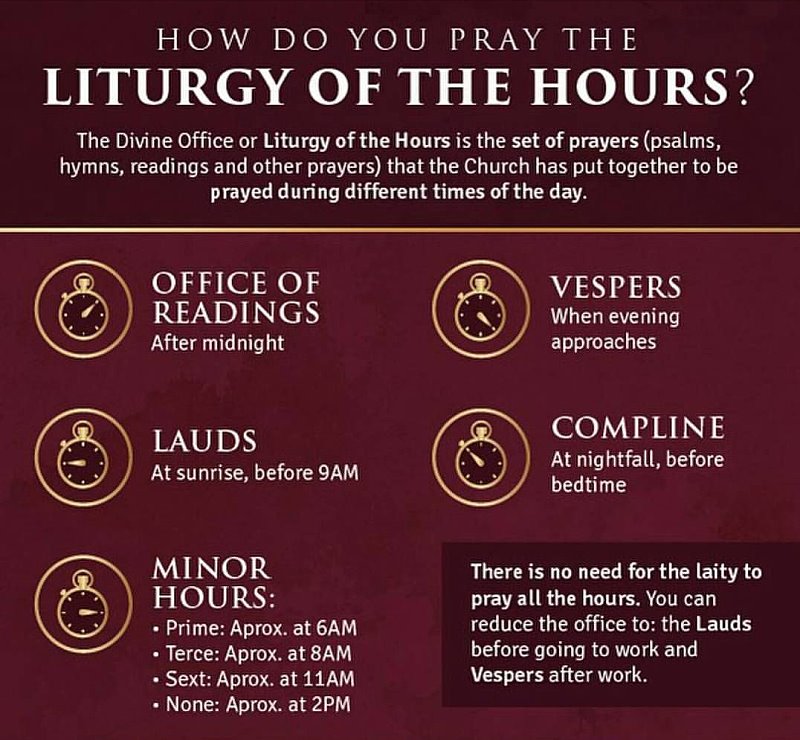
The five Hours
of the Divine Office are:
Office of
Readings
"The office of
readings seeks to provide God's people, and in
particular those consecrated to God in a special way,
with a wider selection of passages from sacred Scripture
for meditation, together with the finest excerpts from
spiritual writers. Even though the cycle of scriptural
readings at daily Mass is now richer, the treasures of
revelation and tradition to be found in the office of
readings will also contribute greatly to the spiritual
life" (General Instruction of the Liturgy of the
Hours [GILH], no. 55).
Morning Prayer
"As is clear
from many of the elements that make it up, morning
prayer is intended and arranged to sanctify the morning.
St. Basil the Great gives an excellent description of
this character in these words: "It is said in the
morning in order that the first stirrings of our mind
and will may be consecrated to God and that we may take
nothing in hand until we have been gladdened by the
thought of God, as it is written: 'I was mindful of God
and was glad' (Ps 77:4 [Jerome's translation from
Hebrew]), or set our bodies to any task before we do
what has been said: 'I will pray to you, Lord, you will
hear my voice in the morning; I will stand before you in
the morning and gaze on you' (Ps 5:4-5)."
"Celebrated as
it is as the light of a new day is dawning, this hour
also recalls the resurrection of the Lord Jesus, the
true light enlightening all people (see Jn 1:9) and "the
sun of justice" (Mal 4:2), "rising from on high" (Lk
1:78). Hence, we can well understand the advice of St.
Cyprian: "There should be prayer in the morning so that
the resurrection of the Lord may thus be celebrated" (GILH,
no. 38).
Daytime Prayer
(can be prayed
at Midmorning, Midday, or Midafternoon)
"Following a
very ancient tradition Christians have made a practice
of praying out of private devotion at various times of
the day, even in the course of their work, in imitation
of the Church in apostolic times. In different ways with
the passage of time this tradition has taken the form of
a liturgical celebration.
"Liturgical
custom in both East and West has retained midmorning,
midday, and midafternoon prayer, mainly because these
hours were linked to a commemoration of the events of
the Lord's passion and of the first preaching of the
Gospel" (GILH, no. 74-75).
Evening Prayer
"When evening
approaches and the day is already far spent, evening
prayer is celebrated in order that 'we may give thanks
for what has been given us, or what we have done well,
during the day.' We also recall the redemption through
the prayer we send up 'like incense in the Lord's
sight,' and in which 'the raising up of our hands'
becomes 'an evening sacrifice' (see Ps 141:2). This
sacrifice 'may also be interpreted more spiritually as
the true evening sacrifice that our Savior the Lord
entrusted to the apostles at supper on the evening when
he instituted the sacred mysteries of the Church or of
the evening sacrifice of the next day, the sacrifice,
that is, which, raising his hands, he offered to the
Father at the end of the ages for the salvation of the
whole world.' Again, in order to fix our hope on the
light that knows no setting, 'we pray and make petition
for the light to come down on us anew; we implore the
coming of Christ who will bring the grace of eternal
light.' Finally, at this hour we join with the Churches
of the East in calling upon the 'joy-giving light of
that holy glory, born of the immortal, heavenly Father,
the holy and blessed Jesus Christ; now that we have come
to the setting of the sun and have seen the evening
star, we sing in praise of God, Father, Son, and Holy
Spirit…'" (GILH, no. 39). Click
HERE to learn more.
Night Prayer
"Night prayer is
the last prayer of the day, said before retiring, even
if that is after midnight" (GILH, no. 84).The Psalms
that are chosen for Night Prayer are full of confidence
in the Lord.